
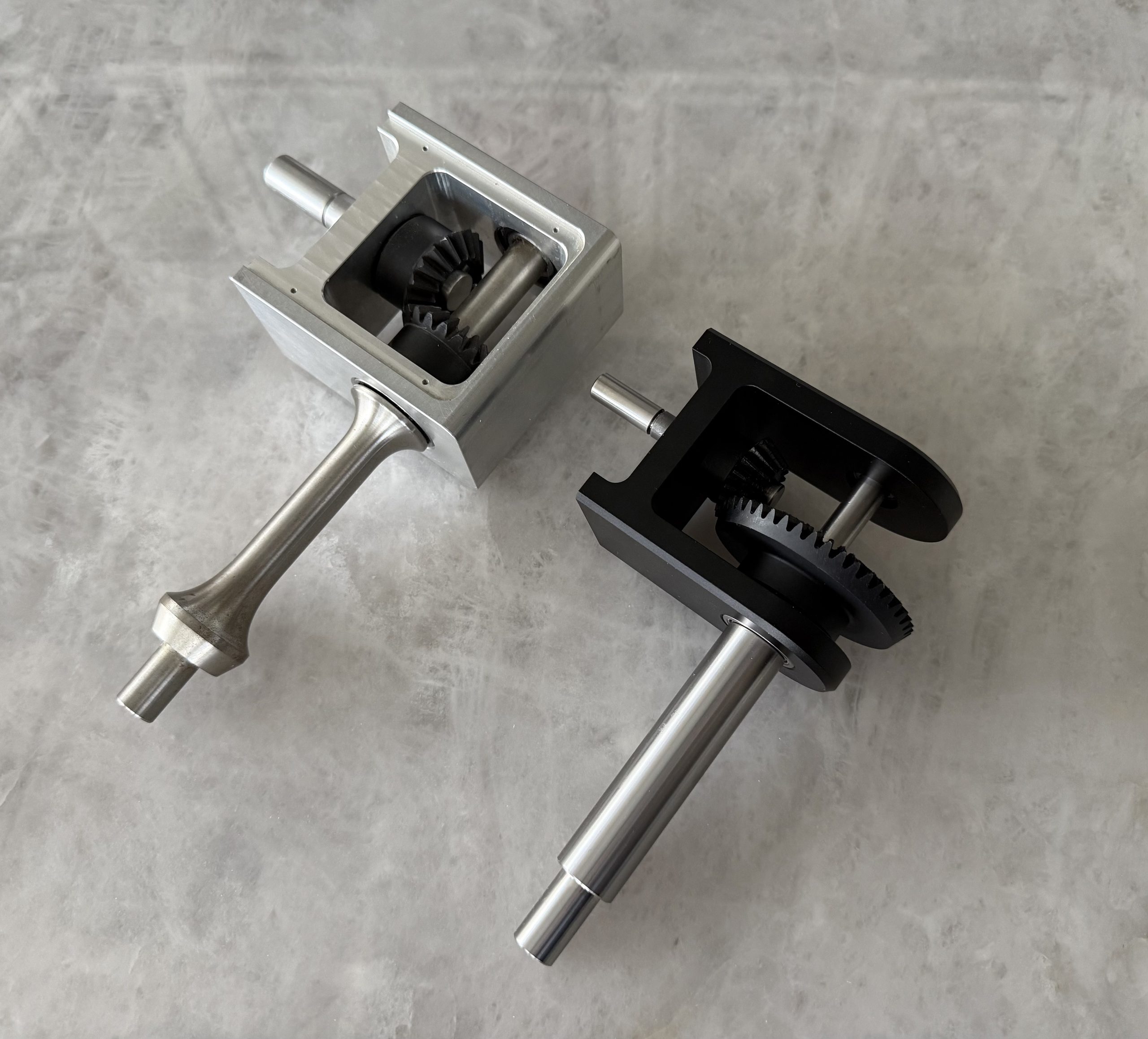
This is where the HG-1 started.
On the left is the gearbox from one of the original HG-1 prototypes. It is, in retrospect, hilariously over-engineered. A big chunk of machined aluminum, substantial bevel gears, ground stainless-steel shafts, and a 1:1 gear ratio.
Basically, built like a tank.
At the time, that was partly the point. We were designing our first grinder and weren’t particularly interested in figuring out how little material we could get away with. We wanted something rigid, precise and mechanical, and we wanted it to feel like it would still be working long after we were gone.
More than a decade later, some of those decisions still make perfect sense. Others gave us somewhere to improve.
On the right is the gearbox from the HG-1 Prime. More refined, definitely more elegant. Smaller in stature but more to offer.
The basic idea hasn’t changed. It’s still a simple mechanical gearbox built around ground stainless-steel shafts. But the Prime uses a 2.5:1 gear ratio, giving considerably more mechanical advantage at the handle and in a smaller footprint as well.
It’s also a good illustration of how we tend to develop products. We don’t change things simply because they’re old. If something works, it stays. When we find a genuinely better way of doing something, we change it.
Thirteen years separate these two gearboxes.
There’s a lot of HG-1 history sitting on that table.